How Personalized Experience Centers Are Transforming Healthcare
A hospital executive visiting an innovation center may want to understand how emerging technology could support operational priorities. A clinician may be interested in new tools and clinical workflows. A healthcare partner might want to explore research, digital transformation, or future models of care.
Each visitor has different questions, yet traditional demonstrations often present the same information to everyone.
Personalized Experience Centers offer a more flexible approach. By bringing together AI, interactive displays, immersive technology, and real-time information, healthcare organizations can create environments that adapt to different audiences and interests.
Rather than relying on a fixed presentation, these environments can help visitors explore information relevant to their roles and goals.
The Healthcare Experience Center Is Becoming More Personal
Healthcare organizations use Experience Centers and innovation spaces to demonstrate new technologies, communicate strategic initiatives, support education, and engage partners.
Traditionally, these environments have relied on planned presentations and predetermined demonstrations. While effective for communicating core messages, this approach can make it difficult to address the different priorities of everyone in the room.
Personalized experiences create opportunities to adapt the content.
A hospital leader could explore healthcare technology through the lens of operational efficiency. A clinical innovation team could focus on emerging applications and workflow considerations. A prospective partner could explore relevant research or technology capabilities.
The same physical environment can support these different conversations without requiring an entirely new setup for every audience.
What Makes a Healthcare Experience Personalized?
Personalization means making the information and interactions relevant to the visitor, while maintaining appropriate safeguards for sensitive information.
Tailoring Experiences to Healthcare Roles
Healthcare leaders, clinicians, researchers, educators, and industry partners approach information from different perspectives.
An interactive environment can present different content based on the audience's interests, helping visitors explore the topics most relevant to their responsibilities.
For example, an innovation showcase might present an overview of an emerging technology before allowing visitors to explore its technical capabilities, potential applications, or operational considerations.
Making Complex Information Easier to Explore
Healthcare organizations manage complex systems, research, and processes that can be difficult to communicate through traditional presentations.
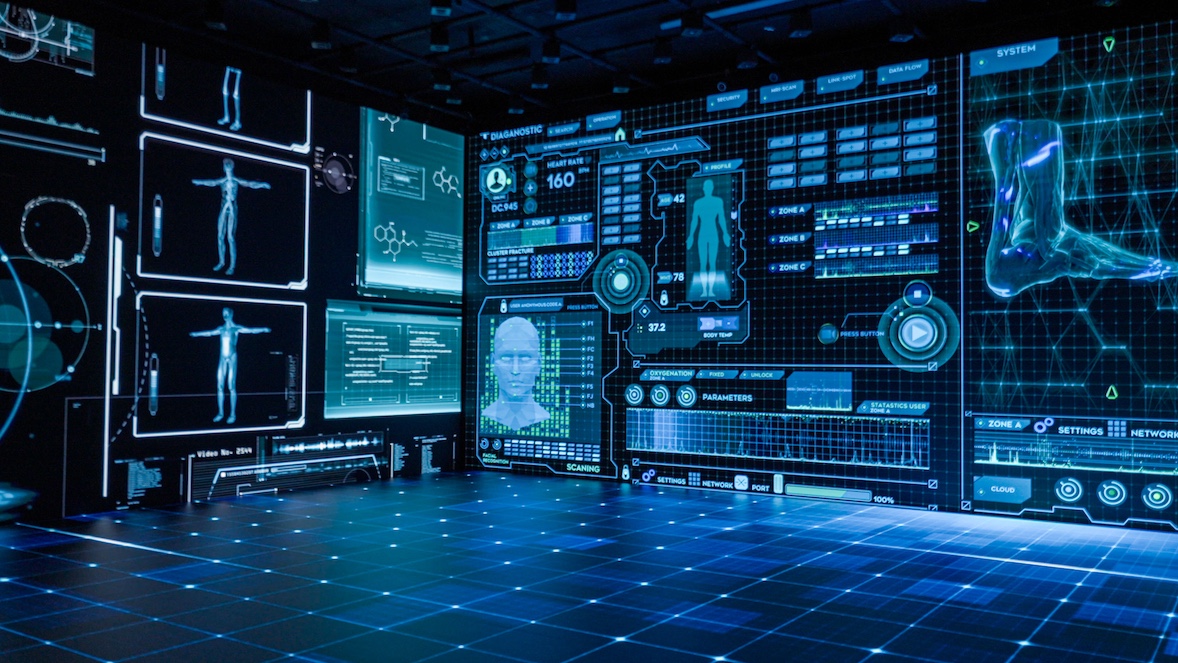
Interactive data visualization, immersive displays, and 2D or 3D representations can help make these topics more accessible to different audiences.
Visitors can explore specific concepts, ask questions, and follow related information rather than relying on a single linear presentation.
Bringing Current Information Into the Experience
Healthcare innovation is constantly evolving. Research developments, organizational initiatives, technology demonstrations, and educational content can change over time.
Connecting Experience Centers to approved, up-to-date information can help organizations maintain relevant content and reduce reliance on static presentations that quickly become outdated.
Supporting AI-Powered Discovery
AI can help visitors navigate large collections of organizational knowledge, find relevant information, and explore questions that were not anticipated when a presentation was created.
In healthcare environments, these systems should operate within defined information boundaries and appropriate governance. They should not expose protected health information or present unverified output as clinical guidance.
From Interactive Displays to Intelligent Healthcare Environments
An interactive display responds to a visitor's selections. An intelligent environment can use context to help determine what information should appear next.
Imagine a healthcare innovation center where a visitor asks about digital transformation. The environment could surface approved information about relevant technologies, organizational initiatives, and related use cases. A follow-up question could lead to an interactive visualization that helps explain how a system or process works.
AI, immersive displays, real-time visualization, computer vision, and connected systems can help create these more responsive experiences.
The purpose is not to replace human expertise. It is to give people better ways to explore complex information and support more productive conversations.
How AI Enables Personalized Healthcare Experiences
Healthcare organizations hold extensive institutional knowledge, including approved procedures, research, technology information, and operational documentation.
AI can help make this information more accessible by connecting questions to relevant knowledge and supporting new ways to visualize and explore it.
Vū's approach centers on turning organizational knowledge, data, and procedures into intelligent, real-time experiences. Its proprietary Procedural Intelligence Engine is designed to help environments interpret context and respond to human interaction.
For healthcare organizations, this approach offers possibilities for innovation showcases, technology demonstrations, workforce education, and stakeholder engagement.
Any use involving clinical information, patient-facing interactions, or personal data requires appropriate validation, privacy controls, accessibility considerations, and oversight. Personalization does not require using identifiable patient information; many experiences can be tailored by audience, topic, or visitor-selected interests.
The New Vū Experience Center
Vū is demonstrating this approach at its approximately 30,000-square-foot Experience Center in Tampa.
The center combines Agentic AI, immersive displays, computer vision, robotics, and real-time visualization to show how AI can move beyond traditional computer screens and into physical environments.
At the center of the experience is Vū's proprietary Procedural Intelligence Engine, a local AI platform built on NVIDIA DGX infrastructure. The technology is designed to transform organizational knowledge, data, and procedures into intelligent, real-time experiences.
Visitors can explore environments that respond to live conversations, visual knowledge mapping, interactive data, immersive 2D and 3D spaces, digital twins, and physical AI applications.
These capabilities demonstrate how a physical environment can adapt to an interaction and help people explore complex information in a more engaging way.
Building Healthcare Experiences Around People, Not Presentations
Healthcare Experience Centers have an opportunity to become more than spaces for displaying technology. They can support discovery, education, collaboration, and conversations tailored to different audiences.
As AI and immersive technology evolve, healthcare organizations can explore new ways to communicate innovation, demonstrate capabilities, and make institutional knowledge easier to navigate.
The objective is to create environments that respond to what people need to understand while maintaining the trust, privacy, and accuracy that healthcare requires.