What Is Experiential Marketing? Creating Experiences People Remember
.jpg)
People can scroll past an ad in seconds. They can skip a video, ignore an email, or forget a social post almost as quickly as they saw it.
An experience is different.
Experiential marketing gives people a chance to interact with a brand rather than just see it. Instead of telling an audience what a company represents, it creates an environment where they can experience it for themselves.
From immersive brand activations and interactive installations to pop-ups, events, Experience Centers, and digital experiences, experiential marketing is becoming an increasingly important way for brands to create stronger connections with their audiences.
What Is Experiential Marketing?
Experiential marketing uses physical or digital experiences to engage people directly with a brand, product, service, or idea.
Rather than relying exclusively on traditional advertising, experiential campaigns invite audiences to participate.
That participation can take many forms. A visitor might interact with a product demonstration, step into an immersive environment, create personalized content, explore an interactive display, or participate in an experience that responds to their actions.
The goal is not simply to attract attention.
It is to create a moment people remember.
A successful experiential marketing campaign gives people something to do, discover, or feel. It turns a brand message into something tangible.
Why Experiential Marketing Works
The strongest experiential marketing experiences create a two-way interaction.
Traditional advertising largely communicates from the brand to the audience. Experiential marketing creates an opportunity for the audience to interact with the brand in return.
That can make the experience more memorable and more meaningful.
For example, instead of simply showing a new product on a display, a brand could let visitors interact with it. Instead of presenting a company's capabilities through a presentation, an Experience Center could allow visitors to explore those capabilities themselves.
This shift from watching to participating is a major part of what makes experiential marketing powerful.
It can also give brands an opportunity to create experiences that are more relevant to individual audiences. Different visitors can explore different content, interact with different elements, and take away different stories from the same physical environment.
What Makes an Experiential Marketing Campaign Effective?
Not every interactive installation automatically becomes a great experience.
The technology may attract someone initially, but the experience itself needs to have a reason for being there.
The most effective experiential marketing campaigns typically have a few things in common.
They Have a Clear Purpose
The experience should support a larger brand or business objective.
That could mean introducing a new product, generating awareness, creating leads, educating customers, building brand loyalty, or simply giving an audience a memorable way to interact with the brand.
They Put the Audience First
An experience should be designed around what the audience wants to do, not just what the brand wants to show.
The best activations create opportunities for discovery rather than forcing visitors through a predetermined sales pitch.
They Encourage Participation
Interaction gives people a reason to stay engaged.
That could be as simple as exploring content on an interactive display or as advanced as an AI-powered experience that responds to a visitor's questions and actions.
They Create Something Worth Remembering
A strong experiential marketing campaign gives people a story to take with them.
The experience might be surprising, useful, entertaining, personalized, or completely new. What matters is that it creates a moment that stands out.
The Role of Technology in Experiential Marketing
Technology has expanded what experiential marketing can be.
Immersive displays can transform physical spaces. Computer vision can allow environments to respond to movement. AI can generate or adapt content. Real-time data can change what people see. Digital twins can bring physical spaces and systems into an interactive environment.
These technologies make experiences more dynamic, but they should serve the experience rather than become the experience.
The question is not simply, "What technology can we put in this activation?"
It is, "What can we let people experience that wasn't possible before?"
That distinction can turn technology from a visual attraction into something that actually strengthens the brand interaction.
From One-Time Activations to Ongoing Experiences
Experiential marketing has traditionally been associated with events, pop-ups, trade shows, and temporary brand activations.
Those are still important. But brands are increasingly creating experiences that exist beyond a single event.
Experience Centers are one example.
Instead of building an activation that disappears after a few days, a brand can create a permanent environment where customers, employees, partners, and prospects can interact with its products, ideas, and technology over time.
The experience can also evolve.
New content can be added. Interactive elements can change. AI can create new ways to explore information. Real-time data can keep the environment current.
This makes experiential marketing less about creating one moment and more about creating an environment that can continue generating moments.
How Vū Helps Bring Experiential Marketing to Life
Vū sits at the intersection of immersive technology, AI, and physical experiences, helping organizations create environments where audiences can do more than simply consume content.
Its Experiences platform brings together technologies such as interactive displays, immersive environments, AI-powered experiences, real-time visualization, and intelligent content to create more dynamic ways for people to interact with information.
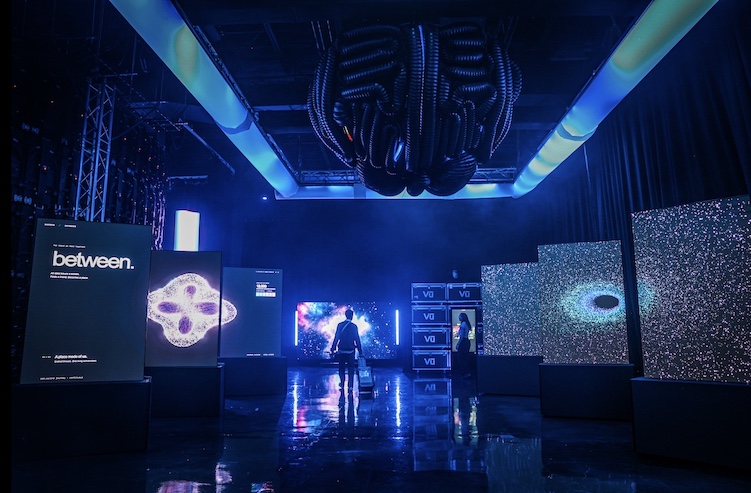
Vū's new Experience Center in Tampa puts that approach into practice, combining Agentic AI, immersive displays, computer vision, robotics, and real-time visualization in a physical environment designed to respond to human interaction.
The broader opportunity is to make experiential marketing more responsive and more relevant. Instead of creating the exact same interaction for every person, technology can help experiences adapt based on what someone wants to explore and how they engage.
The Future of Experiential Marketing
Experiential marketing is moving beyond the idea of simply creating something that looks impressive.
The next generation of experiences will be more interactive, personalized, intelligent, and connected.
AI will help experiences respond to people in real time. Immersive technology will make digital information feel more physical. Data will help brands understand what audiences are engaging with. And physical environments will become more dynamic as technology allows them to respond to the people inside them.
But the underlying goal will remain the same.
Create something people want to experience.
Because in a world where audiences are constantly surrounded by content, the brands that stand out may not be the ones that say the most.
They may be the ones that give people something worth experiencing.
.jpg)

