Experience Centers That Deliver Personalized Content
An Experience Center used to have a fairly simple job: show people what a company does. Today, that is no longer enough.
People walk into these environments with different roles, interests, questions, and levels of familiarity. An executive may want to understand the business impact of a technology. A technical leader may want to see how it works. A customer may want to explore a solution specific to their industry. A returning visitor may already know the basics and want to go deeper.
So why should every visitor get the same experience?
The next generation of Experience Centers is moving toward something more responsive: environments where content can change based on who is visiting, what they interact with, the information available in the moment, and what the system learns from the interaction.
Instead of presenting one predetermined story, a personalized Experience Center can help create a different experience for every person in the room.
The Experience Center Is Becoming More Personal
Traditional Experience Centers are often built around a fixed journey. Visitors move from one display to another, watch presentations, explore demonstrations, and receive information that has been planned.
That approach still has value. But today's technology makes it possible to go further.
A personalized Experience Center can adapt content to the person standing in front of it. Their industry, role, interests, previous interactions, and choices can all help determine what information is presented next.
The result is an environment that feels less like a showroom and more like a conversation.
The physical space can become a starting point for exploration rather than a fixed presentation. Visitors can follow what interests them, ask different questions, and discover information in ways that are more relevant to their needs.
What Makes an Experience Center Personalized?
Personalization does not have to mean creating an entirely different physical space for every visitor. It means making the content and interactions more relevant to the person experiencing them.
That can happen in several ways.
Who is visiting. Content can be tailored to different visitors based on their role, organization, or relationship with a brand.
Their industry or area of interest. A healthcare leader may need to see something very different from a manufacturing executive or an educator. The same environment can surface the information that matters most to each audience.
What they interact with. The choices someone makes inside an experience can help determine what appears next, allowing the journey to evolve in real time.
Real-time information. Live data can bring current information into an experience, making content more relevant to what is happening in the moment.
Previous interactions. Returning visitors can pick up where they left off rather than starting from the beginning every time.
AI-generated content. AI can help create or adapt content based on a visitor's questions, interests, and the context of the experience.
Often, the most powerful experiences combine several of these signals.
From Interactive Content to Intelligent Experiences
There is an important difference between an interactive Experience Center and an intelligent one.
Interactive content responds when someone presses a button, selects an option, or moves through a defined journey.
Intelligent content can respond to context.
That distinction opens up a much larger possibility for physical environments.
Imagine an Experience Center where a conversation can surface relevant information on nearby displays. A visitor asks a question, and the environment responds with visual information that helps answer it. A discussion leads to a new topic, and the experience adapts. Data becomes a visual environment. A complex concept can be explored in 2D or 3D.
The environment is no longer simply waiting for the visitor to choose the next slide. It can help shape what comes next.
That is where technologies like AI, computer vision, real-time visualization, immersive displays, and agentic systems begin to work together.
How AI Enables More Personalized Experiences
AI gives Experience Centers another layer of flexibility.
Instead of relying entirely on content that was created and organized ahead of time, AI can help interpret information, generate content, and connect a visitor's questions to the knowledge behind an organization.
This is especially valuable when an organization has a large amount of institutional knowledge, data, and processes that are difficult to communicate through a traditional presentation.
Vū's approach centers on turning that information into intelligent, real-time experiences. Its proprietary Procedural Intelligence Engine is designed to transform an organization's knowledge, data, and procedures into experiences that can understand context and respond to human interaction.
That creates an opportunity for Experience Centers to become more than places where information is displayed. They can become places where information is explored, interpreted, and put into context.
The New Vū Experience Center
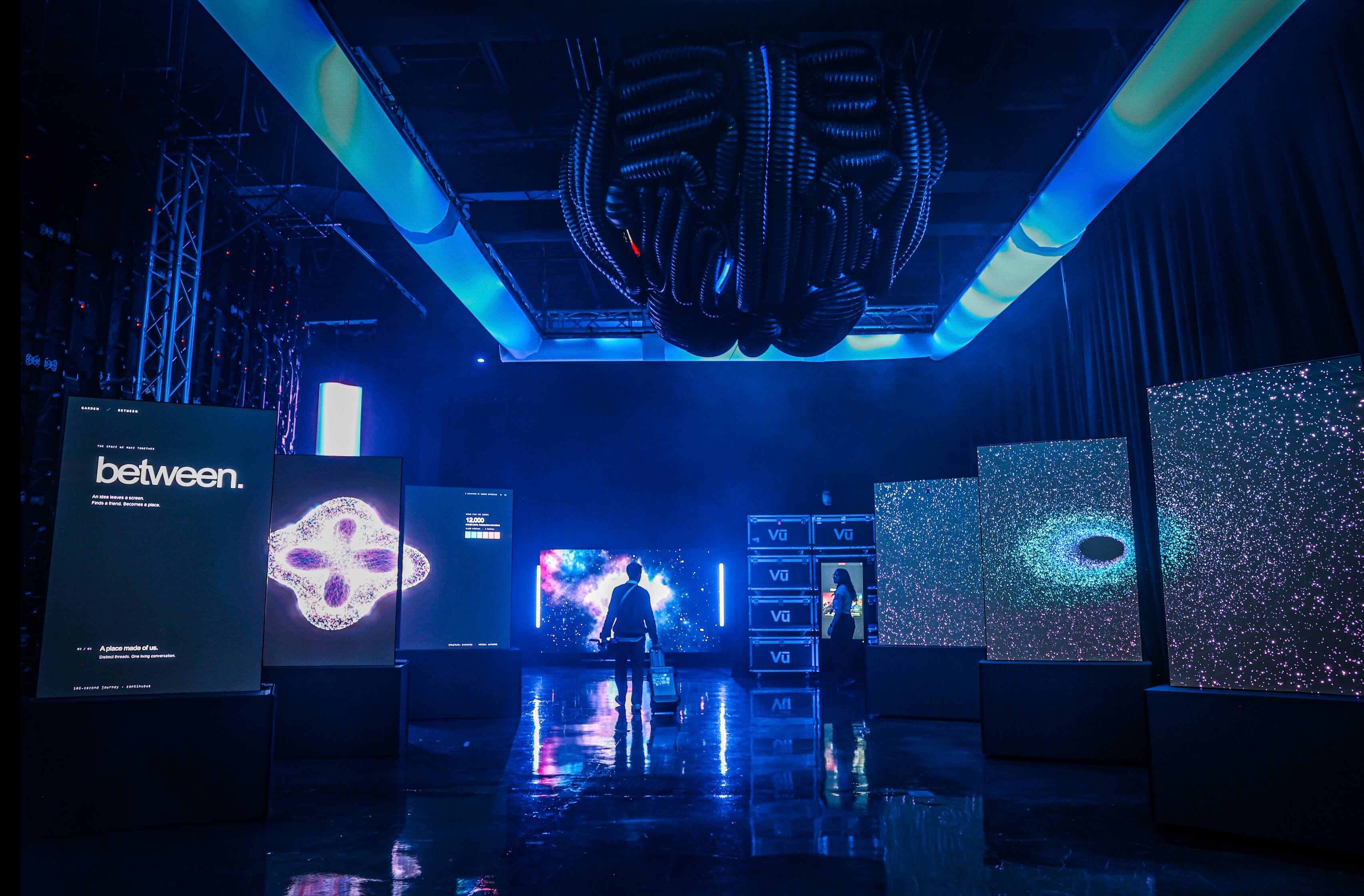
Vū is putting this idea into practice with its new approximately 30,000-square-foot Experience Center in Tampa.
The center brings together Agentic AI, immersive displays, computer vision, robotics, and real-time visualization to demonstrate how AI can move beyond traditional computer screens and into physical environments.
At the center of the experience is Vū's proprietary Procedural Intelligence Engine, a Local AI platform built on NVIDIA DGX infrastructure. The technology is designed to turn organizational knowledge, data, and procedures into intelligent, real-time experiences.
Visitors can see AI-powered environments respond to live conversations, explore real-time visual knowledge mapping and interactive data, experience immersive 2D and 3D environments, and see digital twins, computer vision, robotics, and physical AI in action.
The physical environment itself is designed to change dynamically in response to human interaction.
That makes the Vū Tampa Experience Center more than a place to demonstrate technology. It is an example of how an Experience Center can become an intelligent environment that responds to people and the information around them.
Building Experiences Around the Person, Not the Presentation
The future of Experience Centers is not necessarily about adding more screens, more content, or more technology.
It is about making the experience more relevant.
When an environment can understand context and respond accordingly, organizations can move away from a one-size-fits-all presentation and toward experiences that are more useful, engaging, and memorable.
The same physical space can support different conversations. The same content can be adapted for different audiences. The same technology can create entirely different experiences depending on who walks through the door.
That is the opportunity behind personalized Experience Centers.
And as AI continues to move from the screen into the physical world, the Experience Center can become something fundamentally different: not just a place that shows people information, but an environment that understands what they need and helps them explore it.
.jpg)

