The ROI of Immersive Experiences


Innovation centers have become the front door of the modern enterprise. They’re where customers encounter new ideas, partners explore possibilities, and internal teams align around what’s next.
Yet many enterprise innovation centers are still powered by static screens, scripted demos, and one-way presentations—formats that can’t support real-time decision-making or adaptive conversations.
Most innovation centers don’t fail because the technology is wrong. They fail because the room can’t keep up.
Immersive experiences change that—not by adding spectacle, but by delivering measurable business value when environments respond in real time to the people inside them. When designed correctly, immersive innovation centers shorten sales cycles, increase deal value, improve content ROI, and transform showcase spaces into strategic business assets.
Why Immersive Innovation Centers Matter—and Where They Break Down
Enterprise innovation centers exist to do three things well:
- Communicate complex ideas quickly
- Build confidence in future-focused investments
- Enable meaningful, two-way conversations
The breakdown happens when spaces are built around rigid, pre-rendered content locked into a single narrative. Once installed, these experiences are difficult to update or adapt. Teams rehearse instead of responding. Visitors observe instead of engaging.
We’ve seen innovation centers with world-class hardware sit unused simply because updating the experience felt harder than opening PowerPoint. That disconnect is where immersive experience ROI quietly erodes.
Immersive business environments only perform when they restore flexibility, speed, and relevance to the room.
What “Immersive” Really Means in a Business Context
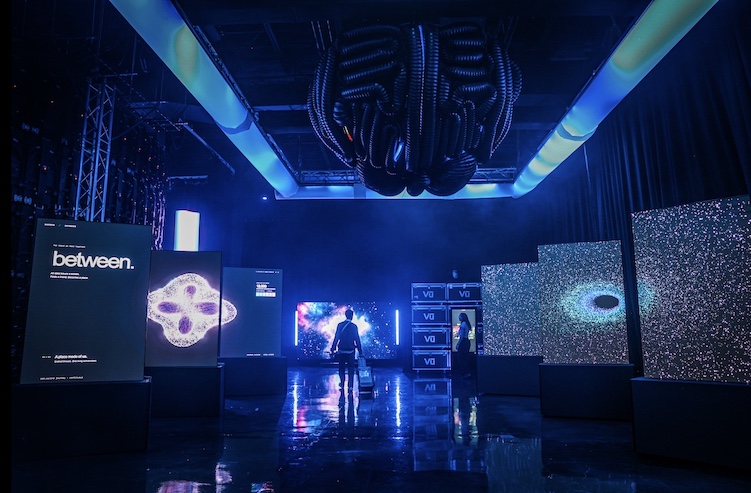
In an enterprise setting, immersive experiences are not about novelty. They’re about spatial storytelling—using scale, depth, motion, and interaction to help people understand complex ideas faster.
Practically, that allows teams to:
- Show ideas instead of explaining them
- Pivot narratives mid-conversation
- Adapt content to different audiences without stopping the meeting
Enterprise conversations are rarely linear. When an interactive innovation center can respond in the moment, it outperforms static demos—not because it’s flashier, but because it stays aligned with intent. That responsiveness is where innovation center ROI begins.
The Business ROI of Immersive Innovation Centers
Faster Sales Cycles and Better Decisions
When stakeholders can see ideas at scale and in context, decision-making accelerates. Immersive sales experiences replace abstraction with shared understanding.
Instead of following up with decks and emails, teams explore scenarios live, answer questions visually, and resolve uncertainty in the room. The result is clearer alignment, shorter sales cycles, and fewer stalled deals.
Higher Deal Value Through Real Conversations
Static presentations show a single outcome. Immersive environments reveal multiple pathways.
As conversations naturally move from product vision to deployment reality, responsive rooms adapt instantly—without resetting the experience. That adaptability often uncovers adjacent opportunities, where deal scope and value expand organically.
Stronger Content ROI Without Rebuilding Everything
Traditional innovation centers rely on custom content designed for one space and one narrative.
Responsive immersive environments allow the same content to support:
- Innovation center briefings
- Executive and board reviews
- Trade shows and roadshows
- Internal alignment and strategy sessions
One content investment. Many business outcomes.
Lower Long-Term Operational Drag
Rigid systems are expensive to maintain. Updates require outside specialists, re-rendering, or downtime.
When internal teams can adapt content and environments themselves, the space remains current, useful, and cost-efficient—without becoming a maintenance burden.
What the Best Software for Immersive Innovation Centers Must Deliver
Organizations evaluating immersive technology for enterprises aren’t just looking for impressive visuals. They need software that supports real conversations, adapts in real-time, and scales across teams.
The best immersive innovation center software:
- Functions as an intelligent CMS, not a simple media player
- Provides unified control of the room, not fragmented systems
- Allows live adaptation without rehearsal
- Is usable by internal teams, not dependent on specialists
- Turns the space into a responsive system, not a static environment
Most platforms solve parts of this challenge. Few solve it holistically.
From Immersive Content to Intelligent, Responsive Rooms
This is where Vū Studio is fundamentally different.
Vū Studio acts as the control layer for the entire room—transforming immersive innovation centers into intelligent, adaptive environments that respond to intent, not scripts.
Instead of managing screens, lighting, cameras, and layouts as separate systems, Vū Studio unifies them into a single interface so content, space, and conversation move together.
The Room Responds to Intent
With Vū Studio, teams can coordinate:
- Visual canvases and spatial layouts
- Live inputs and contextual visuals
- Lighting states and environmental tone
As discussions evolve, the room evolves with them. The space listens instead of leading.
Responsive by Design, Not by Rehearsal
If an immersive space requires a specialist to operate every session, it’s a demo room—not an innovation center.
Vū Studio removes that dependency. Teams can shift narratives, access context on demand, and reframe the environment without breaking momentum. That’s what turns immersive enterprise technology into a decision-making tool.
The Room as an Active Participant
With Vū Studio in place, the room becomes active:
- It facilitates understanding
- It supports exploration
- It adapts to participants
The technology conforms to people—not the other way around.
Measuring ROI Beyond the Install
The real ROI of immersive experiences isn’t measured on installation day. It’s measured in usage.
High-performing innovation centers track:
- How often the space is used
- Whether sales cycles shorten
- Whether deal scope expands
- Whether content investments extend further
- Whether teams take ownership
Responsive rooms get used. Static ones get admired—briefly.
Where Immersive Experiences Actually Deliver Value
Immersive experiences deliver business value when they:
- Accelerate understanding
- Enable real conversations
- Adapt in real-time
- Empower internal teams
- Extend content value across the organization
For organizations searching for the best software to power immersive innovation centers, the differentiator isn’t visual impact on day one—it’s sustained relevance over time.
The difference isn’t how impressive the room looks. It’s whether people choose to use it on day thirty.