Scaling Beyond the Four Walls: How to Take Your Innovation Center on the Road
.jpg)
.gif)
Most innovation centers are designed to live in one place. They’re carefully built, tightly integrated, and often bound to a single room, a single team, or a single headquarters location.
Inside those four walls, they work.
Outside of them, the experience often collapses into slides, videos, or simplified talking points.
That gap is the real limitation.
Today, enterprise conversations don’t happen in one building. They happen at trade shows, client sites, partner offices, pop-up environments, and roadshows across the globe. If innovation stays fixed in place, it stops showing up where decisions are actually being made.
To scale, innovation has to travel — and it has to travel without losing intelligence, continuity, or impact.
The Real Problem Isn’t Mobility. It’s Continuity.
Most organizations don’t struggle to move hardware. They struggle to move experience.
When teams leave their innovation center, they often lose:
- The structure of the story
- The ability to pivot in real time
- The responsiveness of the environment
- Confidence that the experience will behave the same way everywhere
The result is fragmentation.
Every location becomes a one-off. Every event feels different. Every team improvises.
Innovation doesn’t fail because the ideas aren’t strong. It fails because the experience isn’t portable.
This is why portable innovation centers and mobile innovation experiences matter — not as physical objects, but as systems of continuity.
What It Actually Means to Take an Innovation Center on the Road
Taking an innovation center on the road doesn’t mean rebuilding it at every location. It means packaging the experience itself — the content, logic, interaction, and narrative flow — so it can be deployed anywhere with consistency.
Instead of asking:
“How do we recreate this in a new space?”
The better question becomes:
“How do we make this experience available everywhere?”
That shift is what enables scalable innovation platforms and real-time experience platforms to work across environments, teams, and regions.
Vū Studio: The Global Container for Innovation Experiences
Vū Studio is designed to be the system where innovation experiences live.
It allows organizations to package presentations, immersive content, workflows, narratives, and interactive logic into reusable, deployable experiences stored within a single platform.
Once an experience lives in Vū Studio, it is no longer tied to a room or location. It becomes available on demand, consistent across teams and geographies, and ready to deploy anywhere in the world.
Whether launched inside a headquarters innovation center, activated at a trade show, or deployed at a client site, the experience behaves the same way. The intelligence travels with it.
This is what defines modern enterprise experience platforms and immersive experience platforms: the experience lives in software, not in a space.
Bring Your Experiences — Or Build Them With Vū
Package What You Already Have
For organizations with existing immersive or interactive experiences, Vū Studio makes it possible to:
- Structure and modularize content
- Add interactivity and flexibility
- Store experiences centrally and access them globally
You don’t replace previous investments. You extend their lifespan and reach.
Design Custom Immersive Experiences
For teams starting from scratch, Vū designs custom immersive experiences aligned to:
- Your brand and visual language
- Your narrative and messaging
- Your audience and use case
These experiences are built to be flexible from the start, designed for deployment across innovation centers, roadshows, and enterprise environments.
Use Vū’s Experience Configurators
For teams that prioritize speed and control, Vū offers experience configurators — pre-designed frameworks that allow immersive experiences to be assembled quickly.
Configurators provide:
- Structured storytelling flows
- Proven interaction patterns
- Rapid deployment across environments
This approach is especially effective for innovation roadshow technology and immersive trade show experiences, where timelines are tight and consistency matters.
How Vū One Mini Makes the Experience Physical Anywhere
Once experiences are packaged in Vū Studio, they need a physical form that can travel as easily as the software.
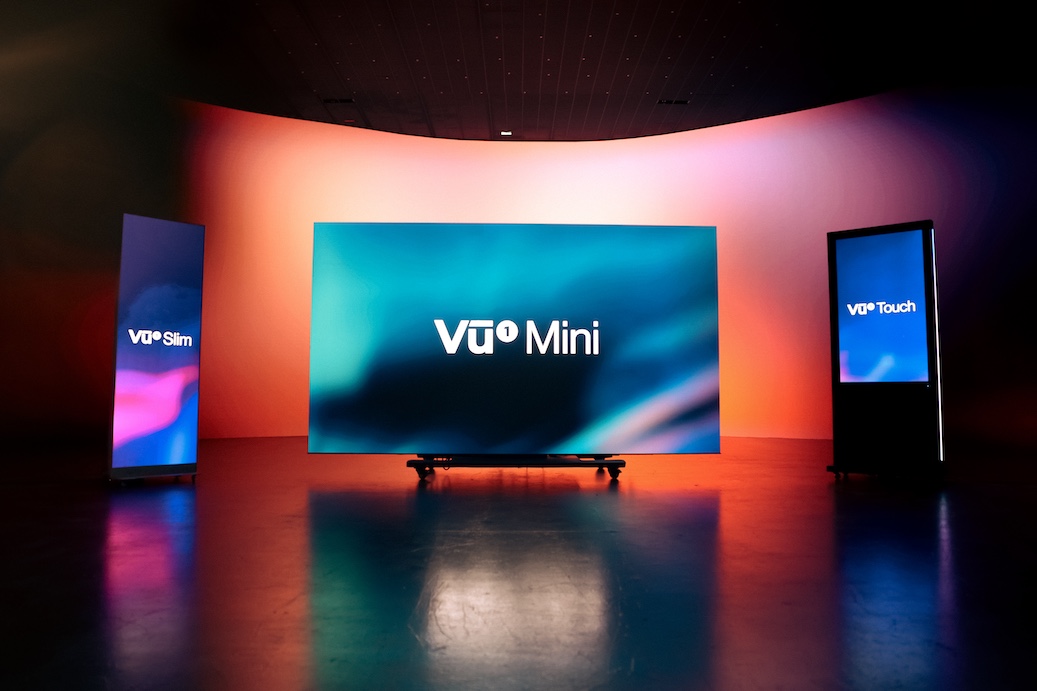
Vū One Mini is a foldable, fully assembled immersive system that ships in a single case. It’s designed to deploy fast and work reliably, without rebuilds or improvisation.
That means no modular construction on site, no fragile setups, and no re-engineering the experience for each location.
Roll it in. Power it up. The experience is ready.
One Experience. Many Places.
With experiences living in Vū Studio and deploying through Vū One Mini, organizations unlock true scalability:
- Run the same experience at a trade show in Las Vegas and a client meeting in London
- Keep messaging consistent while adapting narratives in real time
- Update experiences centrally and deploy changes everywhere instantly
- Reduce duplicated effort and one-off builds
The experience becomes infrastructure, not just an event.
Why This Changes the Economics of Innovation
When innovation experiences are packaged, reusable, and mobile, return on investment compounds.
Organizations see higher returns on content investments, lower cost per engagement, faster deployment cycles, shorter sales conversations, and stronger alignment across teams.
Instead of building new experiences for every moment, teams build systems that travel.
Where Innovation Actually Scales
Innovation scales when:
- Experiences are consistent, not location-dependent
- Intelligence lives in software, not a room
- Teams can adapt narratives without rebuilding
- Deployment friction disappears
For organizations looking to move beyond a single innovation space, the answer isn’t building more rooms. It’s packaging the experience — and making it available everywhere.
Vū Studio and Vū One Mini were built for that reality.
Because the most powerful innovation centers aren’t defined by where they live. They’re defined by how far they can go.